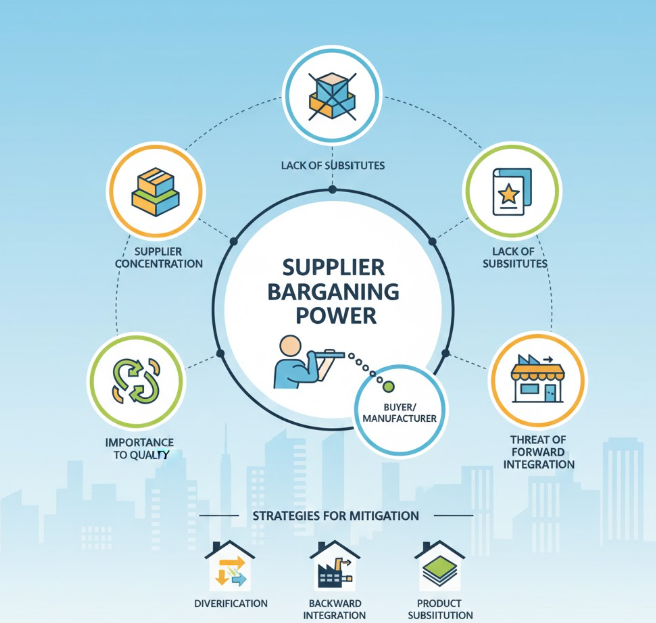
The “Bargaining Power of Suppliers” represents the pressure that resource providers can exert on companies within a specific industry. When suppliers hold high power, they can raise prices, reduce product quality, or impose difficult supply terms, directly increasing production costs and shrinking the profit margins of purchasing firms. In essence, a powerful supplier “shares your profits” without doing the work.
1. Factors That Grant Suppliers Power
-
Supplier Concentration: When a few large companies dominate the supply of an essential material, they hold monopolistic power to dictate terms.
-
Lack of Substitutes: If the material provided is unique and cannot be easily replaced (e.g., specific mobile processors), the supplier becomes the primary controller.
-
Importance of Supplier to the Industry: When a supplier’s product is vital to the buyer’s final product quality, the supplier’s bargaining leverage increases.
-
High Switching Costs: If moving from one supplier to another requires redesigning production lines or retraining staff, the company remains a hostage to the current supplier.
-
Threat of Forward Integration: A supplier holds significant power if they can enter the buyer’s industry themselves (e.g., a leather supplier deciding to open a shoe factory), making them a potential competitor rather than just a provider.
2. Practical Example (The Personal Computer Industry)
In the PC market, suppliers of operating systems (like Microsoft) and processors (like Intel) hold immense bargaining power. Since most assembly companies cannot sell a computer without these core components and there are no widely accepted alternatives, PC manufacturers must pay whatever prices the suppliers demand. Consequently, the bulk of the profit goes to the supplier (upstream) rather than the manufacturer (downstream).
The bargaining power of suppliers is what dictates the “cost structure.” Smart organizations attempt to mitigate this power by diversifying their supplier base, seeking alternative materials, or even threatening “backward integration” (manufacturing the material themselves) to ensure their profits are not at the mercy of an external party.