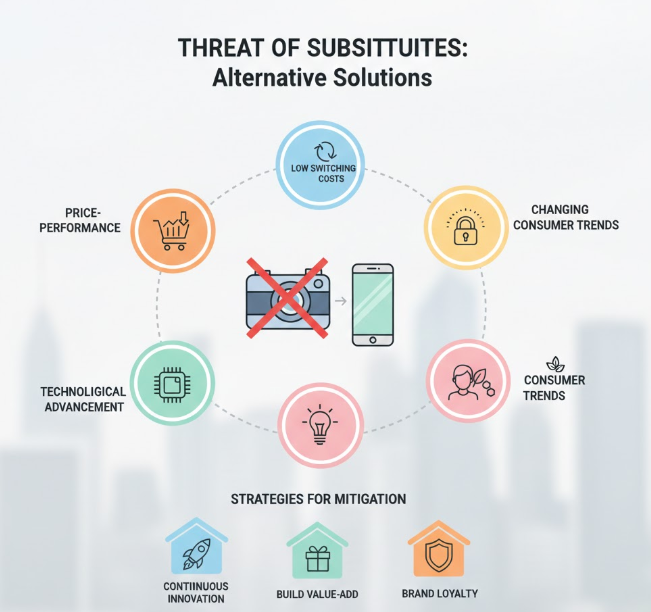
The “Threat of Substitute Products” represents how easily customers can switch from an industry’s current products to alternatives outside that industry that perform the same function. A substitute is the “hidden competitor”; it doesn’t look like your product, but it poses an existential risk by potentially making your entire industry obsolete. This threat intensifies when substitutes offer a price advantage, higher efficiency, or low switching costs.
1. Factors Increasing the Threat of Substitutes
-
Price-Performance Trade-off: If a substitute provides the same benefit at a much lower price, customers will abandon the original product immediately (e.g., free messaging apps vs. traditional international calls).
-
Low Switching Costs: When a customer doesn’t have to pay extra or learn complex skills to use a substitute, the threat becomes very high.
-
Technological Advancement: Sudden innovations can create substitutes that make current products “old-fashioned” (e.g., cloud storage as a substitute for physical storage devices).
-
Shifting Consumer Preferences: Sometimes substitutes are driven by changes in awareness (e.g., natural sweeteners as substitutes for refined sugar for health reasons).
2. Practical Example (The Photography Industry)
Smartphones are the clearest example of a substitute product that decimated the simple digital camera industry. Smartphones are not categorized as “cameras” in the traditional sense, but they perform the function of photography and instant sharing brilliantly and at a lower cost (since they are integrated into a device everyone already owns). This substitute caused customers to stop buying separate cameras, significantly shrinking the camera market.
The threat of substitutes is what dictates an industry’s “shelf life.” Successful companies do not just monitor direct competitors; they keep an eye on external technologies and solutions. To counter substitutes, a firm must invest in continuous innovation and build added value (such as after-sales service or user experience) that a simple substitute cannot easily replace.