Agile Management is a strategic revolution in project execution, aiming to transform rigid organizations into flexible entities capable of adapting to market shifts. It is a philosophy that prioritizes added value and customer satisfaction above all else, relying on close collaboration and continuous improvement.
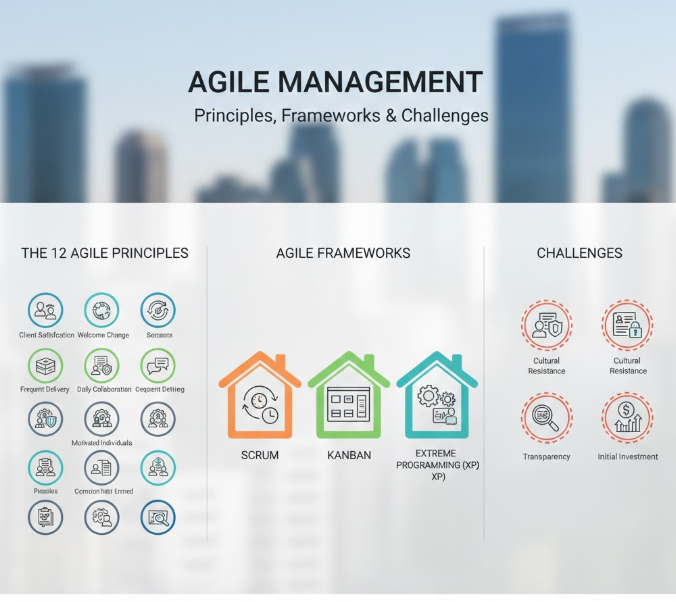
1. The 12 Principles of Agile
-
Customer Satisfaction: Through early and continuous delivery of valuable output.
-
Welcome Change: Even late in the process, to ensure a competitive advantage.
-
Frequent Delivery: Delivering working segments within short timeframes.
-
Daily Collaboration: Business people and developers working together throughout.
-
Support Individuals: Building projects around motivated people and trusting them.
-
Direct Communication: Face-to-face conversation is the best for info sharing.
-
Working Output as Progress: Success is measured by functional products or services.
-
Sustainability: Maintaining a constant and stable pace for all.
-
Technical Excellence: Quality design enhances overall agility.
-
Simplicity: Maximizing the amount of work not done is essential.
-
Self-Organizing Teams: Best results emerge from teams that manage themselves.
-
Regular Reflection: Tuning behavior regularly to increase effectiveness.
2. Popular Agile Frameworks
-
Scrum: The most common, featuring roles like Product Owner and Scrum Master, focused on short sprints and daily stand-ups.
-
Kanban: Focuses on continuous flow and visual boards to limit work-in-progress and optimize efficiency.
-
Extreme Programming (XP): Concentrates on technical quality through practices like pair programming and continuous testing.
3. Challenges in the Agile Transition
-
Cultural Resistance: Difficulty moving away from traditional “Command and Control” styles.
-
Painful Transparency: Agile exposes issues immediately, which can be uncomfortable for those used to polished reports.
-
Initial Investment: Requires significant resources for training and structural changes.
Agile is a mindset that welcomes change as an opportunity for improvement. It aims to build bridges of trust between the team and the client, relying on simplicity and speed of execution. A successful manager in this system focuses on empowering the team and removing obstacles rather than merely issuing commands and close monitoring.