Pricing is not just about placing a number on a product tag; it is the “language” you use to communicate with your customer and define your brand’s position. Price is the message that tells the customer what quality to expect, and it is the most powerful tool for financial managers and marketers to balance sales volume and profit margins.
1. Key Factors Influencing Pricing Decisions
Before setting the final price, three major forces must be balanced:
-
Costs (The Floor). No business can survive if it sells below the cost of production and operation. Fixed and variable costs must be calculated accurately to ensure expenses are covered and a profit margin is achieved.
-
Competition (The Balance). Monitoring competitors is essential, but it doesn’t mean blind imitation. You must know where you stand relative to them: Are you the budget option or the premium choice?
-
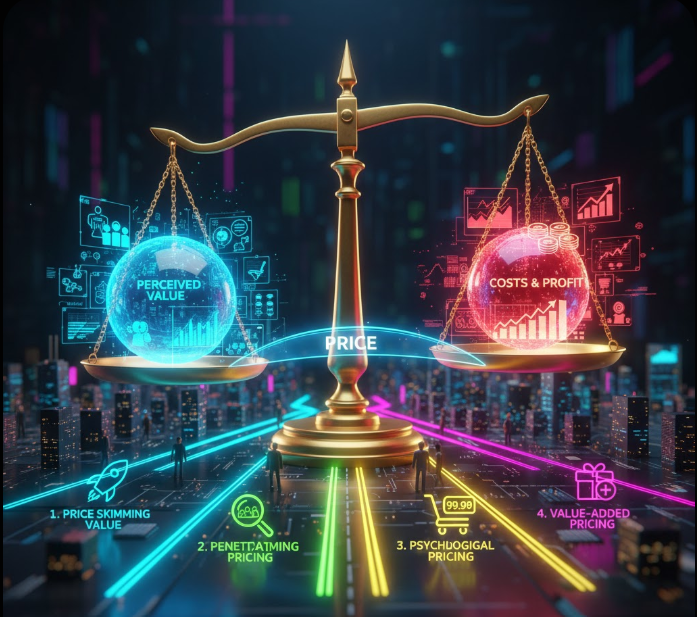
Perceived Value (The Ceiling). This is the most critical factor; the true price is what the customer “believes” the product is worth. If you succeed in convincing the customer of the value, their sensitivity to higher prices will diminish.
2. Global Pricing Strategies
Strategies vary based on business goals and the product life cycle stage:
-
Price Skimming. Setting a high initial price to target early adopters who value exclusivity (common in new technology), then gradually lowering it to reach other segments.
-
Penetration Pricing. Setting a very low price at launch to gain the largest possible market share and build a massive customer base in record time.
-
Psychological Pricing. Using numbers that create a mental impact (e.g., $99.99 instead of $100) or offering bundles that make the middle option appear the most logical and cost-effective.
-
Value-Added Pricing. Focusing on features and services attached to the product to justify a price above the market average, selling a “complete solution” rather than just a commodity.
3. Price and Brand Identity (Positioning)
Price is the fastest way to change how people perceive your product:
-
Premium Pricing. Builds an aura of luxury and scarcity.
-
Economy Pricing. Builds an image of a popular brand accessible to everyone.
-
Dynamic Pricing. Changing prices based on supply and demand (common in hotel bookings or travel apps), requiring advanced technical systems.
Price is the bridge between your effort in product development and the cash flow that ensures your survival. Wrong pricing can kill a great product, while smart pricing can give an ordinary product extraordinary status. Always remember: customers don’t buy the “cheapest price”; they buy the “best value” for their money.