Scrum is a flexible framework used to manage complex projects, based on the principle of “Empiricism”—making decisions based on what has actually happened rather than theoretical forecasts. This methodology relies on breaking down work into short, intensive time cycles, allowing the team to learn and evolve with every new iteration.
1. The Three Core Roles in Scrum
There are no traditional hierarchies in Scrum, but rather complementary roles:
-
Product Owner: The voice of the customer, responsible for prioritizing work to ensure maximum business value. They decide “What” should be built.
-
Scrum Master: The facilitator who ensures the team understands and applies Scrum rules. Their role is to remove obstacles and protect the team from external interference.
-
Development Team: A group of professionals with the skills required to execute the work. The team is “Self-Organizing,” meaning they decide “How” to execute the tasks.
2. Rituals and Time-Boxed Events
Work in Scrum is organized through specific events:
-
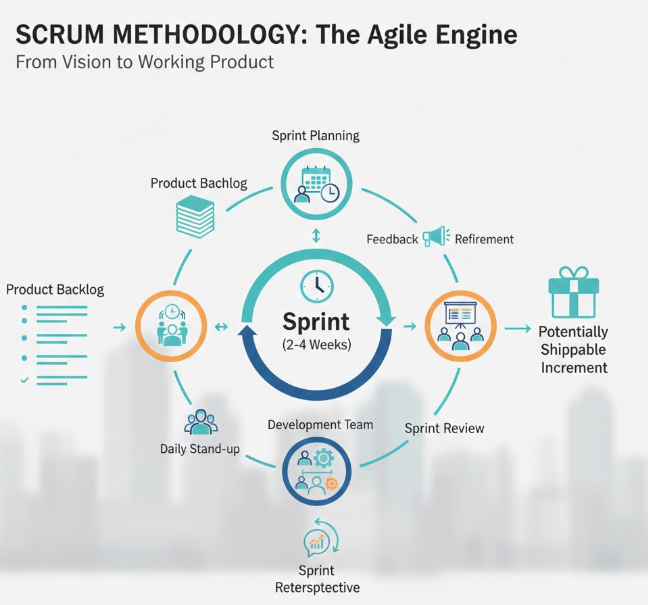
The Sprint: The heart of Scrum, a fixed time-box (usually 2 to 4 weeks) where an idea is transformed into a tangible, working increment.
-
Sprint Planning: Held at the beginning of each sprint to define the tasks to be completed.
-
Daily Stand-up: A quick (15-minute) meeting where the team discusses progress, daily plans, and blockers.
-
Sprint Review: Held at the end of the sprint to present results to stakeholders and gather feedback.
-
Sprint Retrospective: An internal meeting for the team to discuss how to improve their workflow for the next sprint.
3. Artifacts and Outputs
-
Product Backlog: A comprehensive, prioritized list of everything the product needs.
-
Sprint Backlog: The specific tasks selected by the team to be completed in the current sprint.
-
Increment: The functional work completed by the end of the sprint, which must be usable
The Scrum methodology transforms chaos into an organized system through transparency and continuous inspection. It empowers the team to decide and innovate while making the customer a partner in every step. The secret to Scrum’s success is not just in following rules, but in embracing a spirit of collaboration and honesty in evaluating results and developing performance.