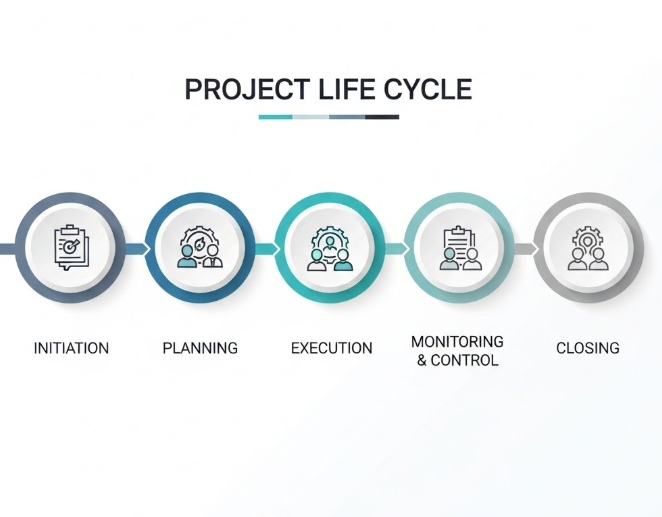
The Project Life Cycle represents the sequential phases any project must pass through to ensure efficient and professional execution. Without understanding these phases, work turns into a series of random actions that consume time and budget without tangible results. Most project management experts divide this journey into four or five core stages.
Phase 1: Initiation
This is the “birth” stage, where the project’s feasibility and high-level objectives are defined.
-
Goal. To answer the question: “Why are we doing this project?”
-
Output. The Project Charter, which gives the green light to start and identifies key stakeholders.
Phase 2: Comprehensive Planning
Once approved, we map out the path precisely. This is the most critical stage to prevent future disasters.
-
Goal. To create a detailed roadmap including the schedule, budget, and risk identification.
-
Output. The Project Management Plan, Gantt Charts, and task assignments.
Phase 3: Execution
This is where talk turns into action; the team begins the actual work of building the project’s deliverables.
-
Goal. To complete the tasks defined in the planning phase with high efficiency.
-
Output. The actual product or service for which the project was designed.
Phase 4: Monitoring & Control
This phase occurs in parallel with execution to ensure everything is moving according to plan.
-
Goal. To measure actual performance against the plan and correct deviations as they occur.
-
Output. Performance reports and plan adjustments when necessary.
Phase 5: Closing
A project does not end simply by delivering the product; essential administrative steps are required to ensure continuity.
-
Goal. To formally hand over deliverables, archive documents, and extract “Lessons Learned.”
-
Output. The final report and the release of resources for other projects.
The Project Life Cycle ensures a smooth transition from abstraction to reality. A successful manager gives each phase its due; rushing into execution without planning leads to failure, and failing to close properly results in the loss of valuable experience. Organization is the secret to sustainable success.