While financial auditing tells you if your numbers are correct, operational auditing tells you if your business is “smart.” Operational auditing is a comprehensive and independent examination of all organization activities to evaluate the efficiency and effectiveness of resource utilization (human, financial, and technical). It is the tool that helps management discover hidden “waste” in daily operations and transform it into opportunities for profit and excellence.
1. The Three Pillars (Economy, Efficiency, Effectiveness)
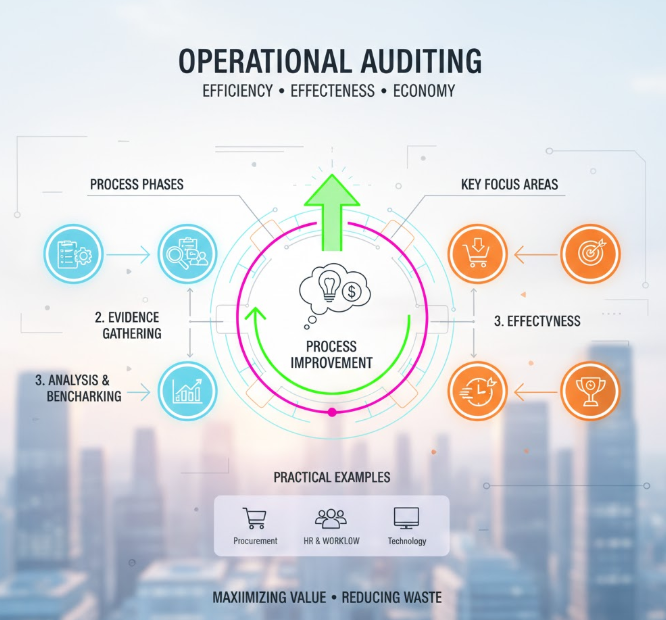
The operational auditor focuses on three core axes known globally as the “3 Es”:
-
Economy. Ensuring that resources are obtained at the required quality and the lowest possible cost (avoiding overspending).
-
Efficiency. Making the best use of available resources to produce the maximum possible output (reducing wasted time and duplicated effort).
-
Effectiveness. The extent to which a department or process succeeds in achieving its pre-defined goals (did we achieve the desired results?).
2. Difference Between Financial and Operational Auditing
It is vital for accountants and managers to distinguish between them:
-
Financial Audit: Looks at the “past” to verify book accuracy according to standards.
-
Operational Audit: Looks at the “future” to suggest improvements that raise productivity and reduce costs.
3. Steps of Implementing an Operational Audit
This process involves consultative rather than purely regulatory stages:
-
Selection and Definition. Choosing a specific department (e.g., Procurement or HR) for examination.
-
Gathering Operational Evidence. Reviewing workflow charts, interviewing employees, and observing task performance on the ground.
-
Analysis and Benchmarking. Comparing actual performance with ideal standards or competitor performance.
-
Providing Recommendations. This is where the added value lies; the auditor provides a report containing “practical solutions” for performance development rather than just listing problems.
4. Practical Examples of Operational Auditing
-
In Procurement: Are we buying from the best suppliers? Is the purchasing cycle too long, causing delays?
-
In Human Resources: Does the task distribution prevent conflicts of interest? Is high employee turnover causing losses?
-
In Technology: Do the systems used serve business goals, or are they complex and delaying progress?
Operational auditing is the “resident management consultant.” It moves an organization from “survival” to “leadership” by closing waste loopholes and increasing the efficiency of both people and machines. Always remember: “It’s not about how many resources you have; it’s about how you manage those resources.”