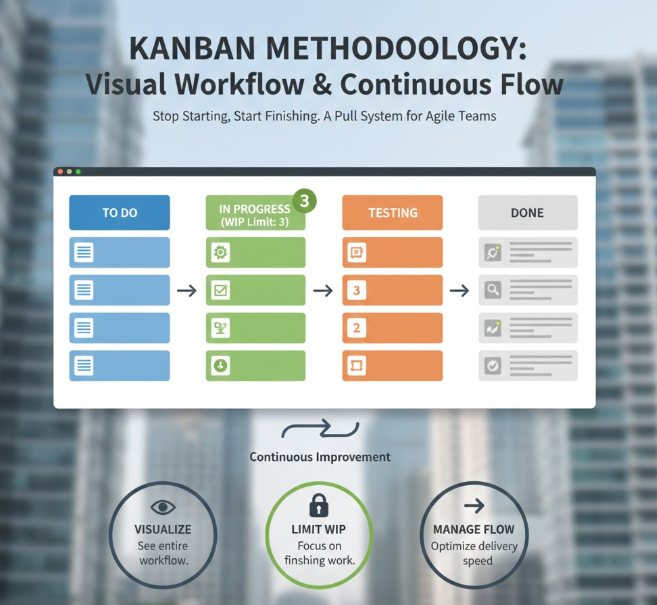
Kanban is a flexible operational management system focused on visualizing the entire workflow and limiting work-in-progress to achieve maximum efficiency. Originating in Toyota’s factories in Japan, it evolved into a cornerstone of Agile management in service and technology sectors. Kanban relies on a “pull” rather than a “push” principle, where new tasks are only started when there is sufficient team capacity.
1. Core Pillars of Kanban
The methodology rests on four fundamental principles:
-
Visualize the Workflow: Using a board divided into columns (e.g., To Do, In Progress, Done) to see work flow clearly.
-
Limit Work in Progress (WIP): Setting a maximum number of tasks the team can handle at once to prevent bottlenecks and multitasking.
-
Manage Flow: Monitoring how tasks transition between columns and analyzing obstacles causing delays to fix them immediately.
-
Continuous Improvement: Working together as a team to constantly evolve processes based on empirical data and results.
2. Differences Between Kanban and Scrum
While Scrum relies on fixed-time cycles (e.g., two-week Sprints), Kanban is a continuous system:
-
There are no fixed, predefined roles in Kanban as there are in Scrum.
-
Success in Kanban is measured by “Cycle Time”—the time it takes for a single task to go from start to finish.
-
Changes in Kanban can happen at any moment; if an urgent task arises, it can be added immediately if there is capacity in the “In Progress” column
Kanban is the ideal solution for teams suffering from too many unfinished tasks and constant pressure. It doesn’t impose radical structural changes but starts with what you do now and helps you improve incrementally through “Clear Vision” and “Limited Focus.” Success in Kanban means to “Stop Starting, and Start Finishing.”