Risk Management is considered one of the most sophisticated skills in project management. It is the systematic process of identifying, analyzing, and responding to risk factors that may emerge throughout the project life cycle. The goal is not to eliminate risks entirely (which is impossible) but to control them to ensure the project stays on its path to success.
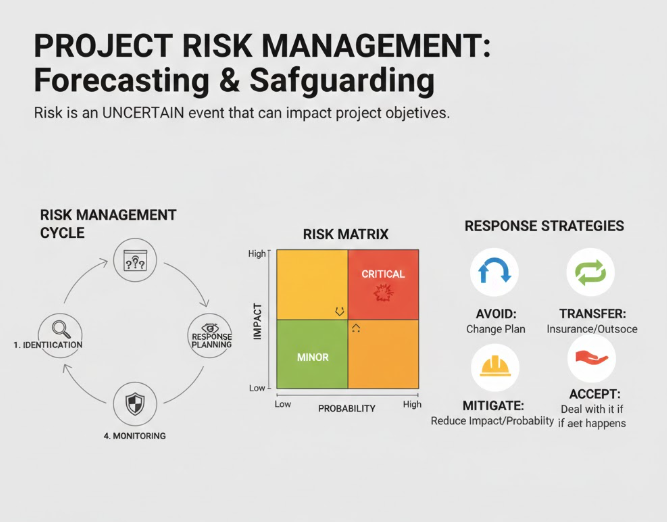
1. The Risk Management Cycle
-
Risk Identification: Brainstorming with the team to anticipate everything that could disrupt work (e.g., supplier delays, technical failures, or currency fluctuations).
-
Qualitative & Quantitative Analysis: Evaluating each risk based on two factors: Probability and Impact. Is this risk minor or catastrophic?
-
Response Planning: Developing “Plan B” for every significant risk.
-
Monitoring & Control: Tracking risks throughout the project to ensure old risks have faded and new ones haven’t emerged.
2. Risk Response Strategies
There are four primary ways to handle any risk:
-
Avoid: Changing the project plan entirely to steer clear of the risk.
-
Transfer: Shifting the responsibility of the risk to a third party (e.g., insurance or outsourcing).
-
Mitigate: Taking actions to reduce the probability of the risk occurring or its impact if it does.
-
Accept: If the risk is minor and the cost of addressing it exceeds its impact, it is accepted and dealt with if it happens.
Risk management is the difference between “Proactive Management” and “Crisis Management.” A manager who maintains an updated Risk Register is a manager who rests easy, knowing that every potential surprise has a pre-planned solution. Success is not the absence of problems; it is the absolute readiness to face them.