If the “Initiation” phase gives a project its life, the Planning Phase gives it its logic and mind. Planning is not just a to-do list; it is a “mental simulation” of the future. The manager and their team attempt to anticipate every step, obstacle, and resource required before a single cent is spent on execution.
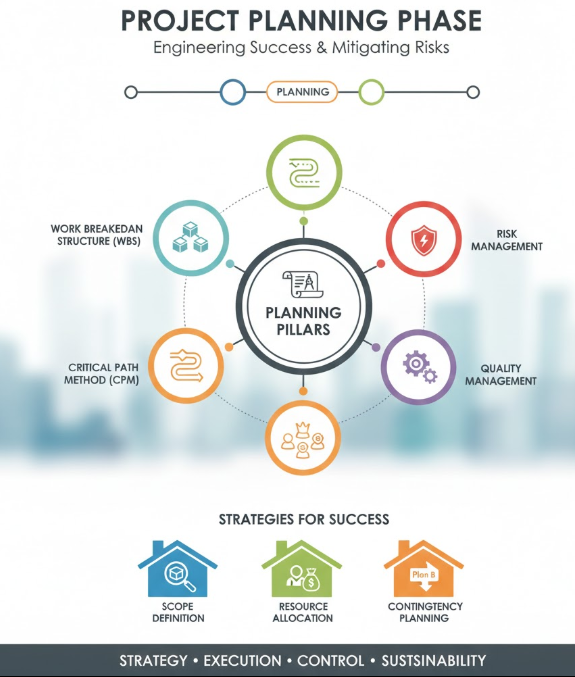
1. The Five Pillars of Professional Planning
-
Work Breakdown Structure (WBS): The backbone of planning. Instead of handling a project as one massive block, it is deconstructed into small “Work Packages.” This allows for accurate cost and time estimation for each part and prevents small tasks from being lost in the big picture.
-
Critical Path Method (CPM): This tool helps managers identify the longest sequence of dependent tasks that must be completed on time to ensure the project isn’t delayed. Any delay in “Critical Path” tasks results in an inevitable delay in the final delivery date.
-
RACI Matrix (Responsibilities Allocation): Ambiguity in responsibilities is the enemy of execution. This matrix defines who is (Responsible, Accountable, Consulted, and Informed) for each task. It ensures everyone knows their role and prevents overlapping authorities.
-
Quality Management Plan: Planning covers more than just time and money; it covers “Standards.” Here, “Success” is defined, and quality measurement methods are established to ensure the final product meets stakeholder expectations.
-
Procurement Planning: “Make or Buy” decisions are made here. Will everything be done in-house, or are external vendors needed? How will they be selected and contracted?
2. Why Does Planning Often Fail?
The primary reason is not a lack of tools, but “Over-Optimism.” Planners tend to underestimate time and costs. A professional manager builds in “Contingency Buffers” for both time and budget to handle unexpected events.
The Planning Phase is an “investment” paid upfront to save against massive losses later. A plan is not a static document; it is a living entity that evolves with reality. However, it remains the only reference that prevents a project from drowning in the chaos of unplanned execution.