The “Threat of New Entrants” is the metric that determines how easy or difficult it is for new players to join a specific sector. In economics, an attractive industry is one that possesses high “walls” that prevent outsiders from easily entering and sharing the profits. Whenever entry is easy, market supply increases, and price competition intensifies, eventually eroding the profit margins of established firms.
1. Barriers to Entry (Defensive Fortresses for Incumbents)
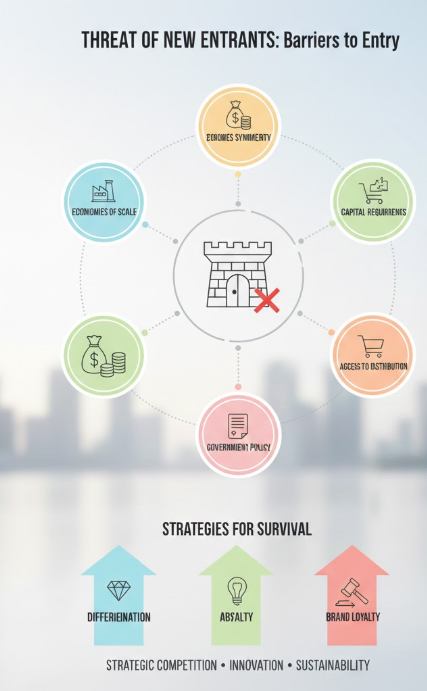
For an industry to remain profitable, new firms must face “barriers to entry” that make the task difficult or costly, including:
-
Economies of Scale: Large established firms produce in massive quantities, reducing unit costs. A new competitor must either start big (which is risky) or accept high costs that prevent price competition.
-
Capital Requirements: Some industries require enormous upfront investments (e.g., automotive or telecommunications), limiting the number of entities capable of venturing in.
-
Access to Distribution Channels: New entrants may struggle to convince retailers or distributors to stock their products instead of trusted, established brands.
-
Absolute Cost Advantages: Older firms often possess advantages money can’t buy, such as patents, exclusive access to raw materials, or cumulative experience (the learning curve).
-
Government Policy: Legal restrictions, difficult licensing, and strict environmental standards can act as legal barriers preventing new players from entering easily.
2. Practical Example (The Pharmaceutical Industry)
The pharmaceutical industry is a classic example of high barriers to entry. To enter, a new company must invest billions in R&D (massive capital), obtain patents (cost advantage and legal protection), and pass rigorous government tests (regulatory barriers). This keeps established firms relatively safe from new competitors, allowing them to maintain high profit margins.
The threat of new entrants determines the “sustainability of profitability” within a sector. Successful firms do not just wait; they constantly work to strengthen entry barriers by building strong brand loyalty, investing in technology, and securing distribution channels to ensure outsiders stay outside the industry walls.