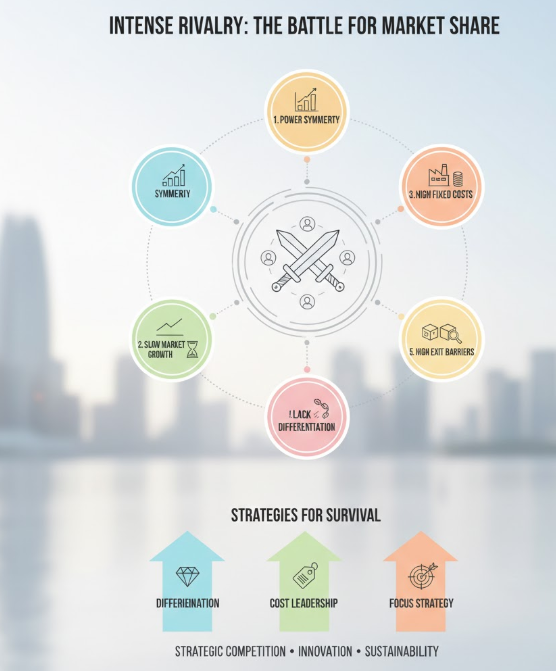
The “Rivalry Among Existing Competitors” is the core of Porter’s Five Forces; it represents the direct, daily pressure firms face from peers. In cutthroat markets, competition becomes a “zero-sum game,” where any market share gain for one firm is a direct loss for its rivals, igniting endless commercial wars.
1. Fundamental Factors Driving Intense Rivalry
-
Symmetry of Power: When competitors have equal resources, no one can dominate easily, leading to prolonged conflicts and immediate counter-moves.
-
Industry Life Cycle: In mature, saturated markets, organic growth is nearly impossible. Firms must grow by “seizing” rivals’ customers, making competition aggressive.
-
High Fixed Costs: In sectors like aviation or hotels, massive fixed costs drive firms to slash prices just to fill capacity. An empty seat or room is a lost opportunity that can never be recovered.
-
Lack of Differentiation: When products are seen as “commodities,” competition focuses solely on “price.” If switching costs are low, firms remain in a constant state of alert.
-
High Exit Barriers: Firms may stay in the market despite losses because exit costs (liquidation, settlements) exceed the cost of continuing, leading to overcrowding.
2. Strategic Responses (How to Survive?)
To counter these pressures, firms adopt three major paths:
-
Differentiation Strategy: Creating unique product value that justifies a premium price and builds customer loyalty.
-
Cost Leadership: Achieving the lowest production costs to remain profitable even during devastating price wars.
-
Focus Strategy: Targeting a very narrow market segment and serving it better than large, distracted competitors.
3. Practical Example (The Commercial Aviation Sector)
The airline industry is a prime example. High fixed costs force airlines to slash ticket prices to fill seats, as a vacant seat represents a total loss. Since the core service is similar, customers choose the lowest price, forcing players to innovate in ancillary services or minimize costs to survive.
Intensity of rivalry acts as the “sieve” that filters out weak firms. Success in such environments requires not just sound financial management, but a “strategic vision” capable of building defensive moats around the brand. The ultimate goal is not to win the price war, but to transcend it by providing value that competitors simply cannot replicate.