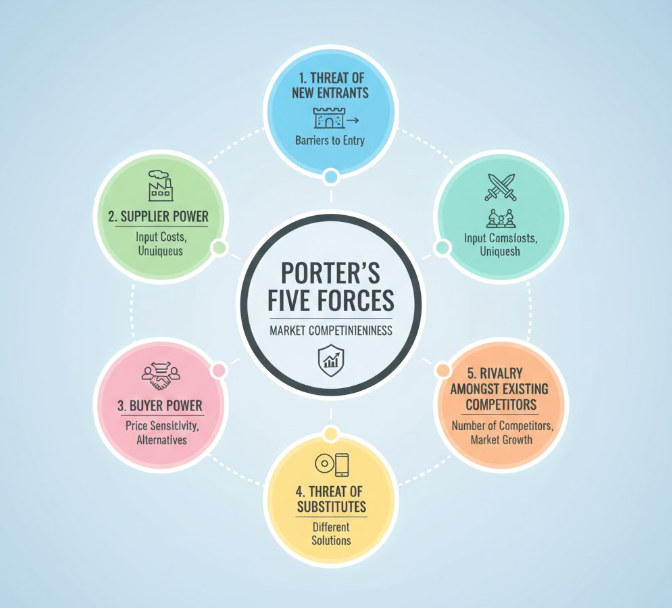
Understanding the competitive environment is about understanding the “balance of power” that governs the market and determines profitability. Porter’s analysis helps organizations identify their strengths and weaknesses and evaluate whether entering a specific industry will yield sustainable returns. This model relies on five fundamental forces.
1. Rivalry Among Existing Competitors
This force focuses on the number of actual competitors and their ability to influence the market. Rivalry is intense when there are many companies of similar size or when market growth is slow, forcing companies into fierce price wars to gain market share, which eventually erodes profit margins.
2. Threat of New Entrants
This refers to how easy or difficult it is for new companies to join an industry. “Barriers to entry” are key; if a market requires massive capital or complex technology, the threat is low. In markets with low barriers, the constant influx of new competitors increases supply and pushes prices downward.
3. Bargaining Power of Suppliers
This studies how much control suppliers have over raw material prices and terms. Suppliers hold power when they are the primary source of an essential material or when switching costs between suppliers are very high. In such cases, suppliers can raise prices directly.
4. Bargaining Power of Buyers (Customers)
This relates to the customers’ ability to pressure for lower prices or higher quality. Buyer power increases when there are few buyers with large volumes, or when they have many alternatives and can switch to a competitor without additional costs.
5. Threat of Substitute Products
A substitute is a different product that performs the same function or meets the same need. The danger of substitutes arises when they offer a price advantage or higher efficiency than the original product, potentially threatening the entire traditional industry.
Porter’s analysis is the “Strategic Compass” that determines the attractiveness of an economic sector. Recognizing these five forces allows managers to make informed decisions. The secret lies not just in facing these forces, but in finding a market position where these pressures are at their lowest, or using innovation to shift the balance of power in the organization’s favor.